
Self-hosted product search in 5 min
What this is
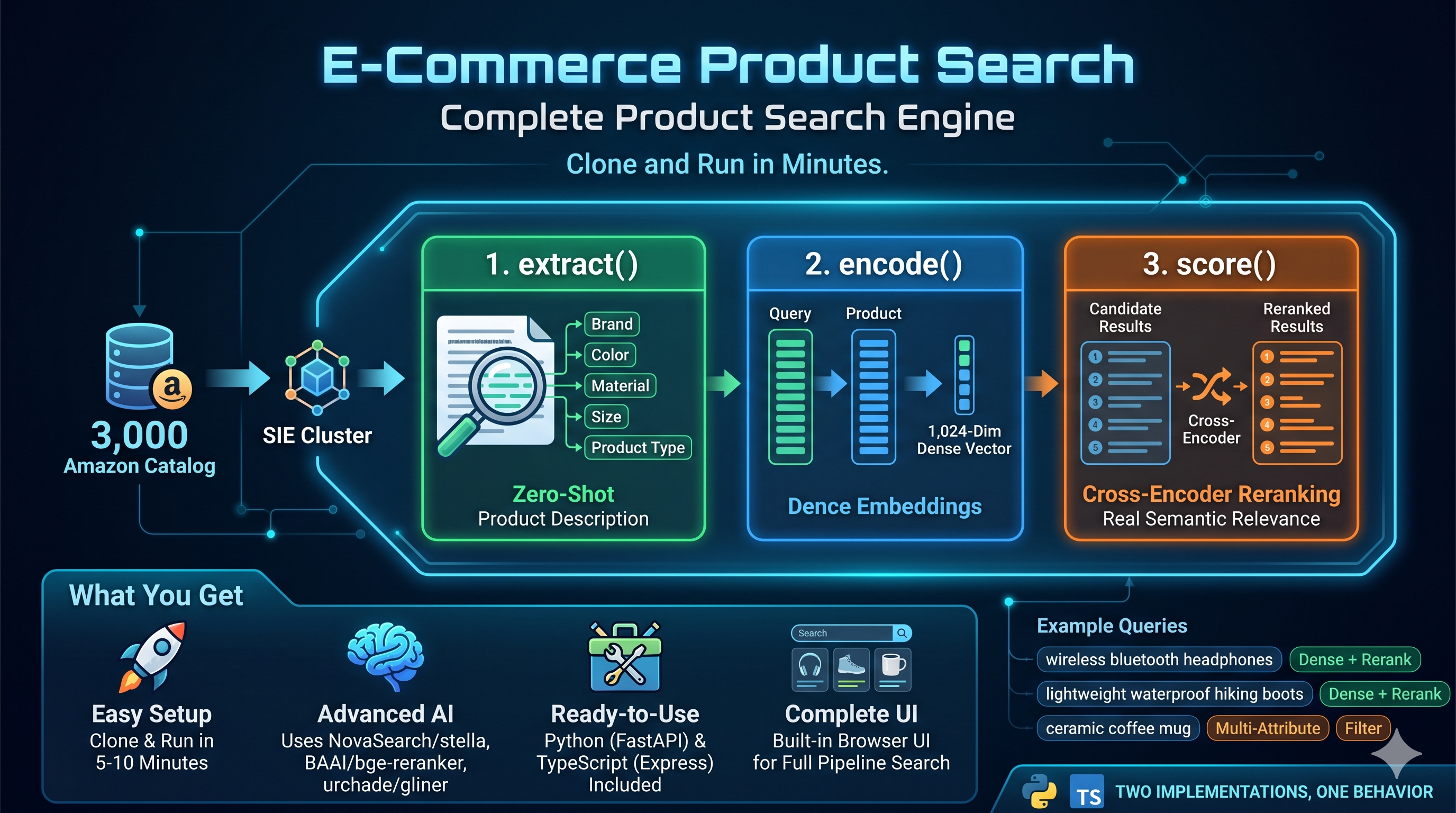
Section titled “What this is”A complete product search demo you can clone and run on a laptop in five minutes. Type wireless bluetooth headphones and get ranked Amazon products back with extracted brand, color, and material filters. The whole pipeline (zero-shot attribute extraction, dense embeddings, cross-encoder reranking) runs through one local SIE server with three SDK calls. No vector DB to provision, no separate reranker service, no hand-rolled regex for attributes.
Built by Vipul Maheshwari.
Try these queries
Section titled “Try these queries”Once the server is running at http://localhost:8888, open it in your browser and try:
| Query | Filter | What it exercises |
|---|---|---|
wireless bluetooth headphones | All Electronics | Dense retrieval plus cross-encoder rerank |
lightweight waterproof hiking boots | none | Multi-attribute semantic match |
gold jewelry for women | none | Style and material phrasing, rerank matters |
ceramic coffee mug | Amazon Home | Category filter applied to extracted attributes |
power drill cordless | brand=DEWALT | Filter on an attribute that was extracted zero-shot |
Each query flows through the full pipeline: encode() the query, vector search against the saved matrix, filter by extracted attributes, score() rerank with a cross-encoder, return the top 10.
Run it locally (5 minutes)
Section titled “Run it locally (5 minutes)”You need Docker, Python 3.12, and roughly 3 GB of disk for the model weights. No API keys, no signup, no cluster.
# 1. Start a local SIE server on CPU.docker run -p 8080:8080 ghcr.io/superlinked/sie-server:latest-cpu-default#   With an NVIDIA GPU:#   docker run --gpus all -p 8080:8080 ghcr.io/superlinked/sie-server:latest-cuda12-default
# 2. In another terminal: clone, install, fetch data.git clone https://github.com/superlinked/siecd sie/examples/ecommerce-product-search
pip install -r python/requirements.txtpython data/fetch_dataset.py
# 3. Build the index and start the search server.python python/ingest.pyuvicorn --app-dir python server:app --port 8888
Open http://localhost:8888 and start searching.
Got a managed SIE cluster?
Section titled “Got a managed SIE cluster?”export SIE_CLUSTER_URL="https://your-cluster-url"export SIE_API_KEY="your-api-key"Everything else stays identical. The defaults in config.yaml point at http://localhost:8080 so env vars are only needed when you are hitting something remote.
Prefer TypeScript?
Section titled “Prefer TypeScript?”Same flow, Node 22+ and pnpm required. See the TypeScript README for the Express version.
How it works
Section titled “How it works”Ingest builds a searchable index once:
extract()pulls structured attributes (brand,color,material,size,product_type) from raw product descriptions withurchade/gliner_multi-v2.1. Zero-shot, no training data, no custom schema work.encode()embeds every product’s title and description into 1,024-dim dense vectors withNovaSearch/stella_en_400M_v5.
The index is just two files on disk (data/embeddings.npy and data/metadata.json).
Search runs this on every incoming query:
encode()the query with a query-side prefix (Stella is asymmetric).- Cosine similarity against the in-memory matrix gives the top 100 candidates.
- Filter by extracted attributes if the request specifies any.
score()reranks the candidates with theBAAI/bge-reranker-v2-m3cross-encoder and returns the top 10.
Three model families, three roles, one endpoint. No per-model container to ship, no GPU scheduling to babysit, no separate reranker service.
API reference
Section titled “API reference”Both backends expose the same three endpoints.
GET /api/search
Section titled “GET /api/search”| Parameter | Required | Description |
|---|---|---|
q | yes | Search query |
category | no | Category filter (matches against the product category) |
brand | no | Brand filter (matches against the extracted brand attribute) |
curl "http://localhost:8888/api/search?q=waterproof+boots&brand=Columbia"Response:
{ "query": "waterproof boots", "filters": { "brand": "Columbia" }, "results": [ { "id": "<product-id>", "title": "<product-title>", "description": "<truncated-product-description>", "category": "AMAZON FASHION", "price": "<number-or-null>", "rating": "<number-or-null>", "image": "<image-url-or-null>", "features": ["<feature-text>", "<feature-text>"], "attributes": { "brand": "Columbia", "color": "<extracted-color>" }, "scores": { "vector": "<similarity-score>", "rerank": "<rerank-score>" } } ]}GET /api/categories
Section titled “GET /api/categories”Returns category counts as [name, count] tuples (feeds the dropdown in the UI).
GET /api/stats
Section titled “GET /api/stats”Returns index size, embedding dims, and the three model names.
Troubleshooting
Section titled “Troubleshooting”| Symptom | Fix |
|---|---|
Connection refused on port 8080 | docker run is not running or crashed. Check docker ps. |
| Ingest seems stuck | First run is downloading ~3 GB of model weights. Check docker logs for progress. |
| Port 8888 already in use | Pick another: uvicorn --app-dir python server:app --port 9000 |
| Filter returns 0 matches | Server logs a warning and falls back to unfiltered top-k so the UI still shows something. |
| On CPU, ingest is too slow | Edit config.yaml, set dataset.sample_size: 300. |
Customize
Section titled “Customize”Both implementations read the same config.yaml. The defaults work out of the box for local Docker. Tune only when you need to.
cluster:  url: "http://localhost:8080"  api_key: ""  gpu: ""                       # set to "l4-spot" or similar when targeting a managed multi-GPU cluster  provision_timeout_s: 600
models:  embedding: "NovaSearch/stella_en_400M_v5"  reranker: "BAAI/bge-reranker-v2-m3"  extractor: "urchade/gliner_multi-v2.1"
extract_labels:  - brand  - color  - material  - size  - product_type
search:  top_k_candidates: 100  top_k_results: 10
ingest:  batch_size_extraction: 8  batch_size_encoding: 32  confidence_threshold: 0.5  junk_text_max_len: 15
dataset:  name: "milistu/AMAZON-Products-2023"  sample_size: 3000  min_description_length: 100
Swap any of the three models for another one in the SIE catalog and the pipeline keeps working. That is the point.
Project layout
Section titled “Project layout”examples/ecommerce-product-search/├── config.yaml├── data/│ ├── fetch_dataset.py│ └── products.json # generated by fetch_dataset.py├── python/│ ├── ingest.py│ ├── search.py│ ├── server.py│ └── requirements.txt├── static/│ └── index.html # shared browser UI└── typescript/ ├── package.json └── src/ ├── ingest.ts ├── search.ts └── server.tsBy Vipul Maheshwari.